• About

Mademoiselle Miss Continued

~ WWI nursing

Mademoiselle Miss Continued

Category Archives: Uncategorized

An Appeal from Norman Derr, October 1917

13 Friday Dec 2013

Posted by annelewis1 in Uncategorized

≈ Leave a comment

Norman wrote a letter home appealing to the women of Atlanta to help her once again bring Christmas cheer to French soldiers.  In the previous year of 1916 they had sent hundreds of Christmas presents to Norman for her wounded , which was recounted in the post of 30th November 2013.

‘Current Events from a Womens Point of View’

An Appeal from Norman Derr

 Mrs Albert Thornton, chairman of the educational department of the Atlanta Red Cross chapter, has recently received a letter from Miss Norman Derr, who for three years has given her services as a nurse in the French military hospitals.

Miss Derr made a short visit to her relatives in Atlanta in the summer of 1916, and thrilled Atlanta’s Red Cross workers, led by Mrs Richard Johnston with the stories of her hospital work.

Following her address here at the home of Mrs Albert Thornton and elsewhere, Miss Derr was remembered by the Atlanta women who sent her a Christmas box for her soldiers. Still grateful for that, Miss Derr writes about the coming again of Christmas as follows:

“The Christmas tree, I long to realise this year looms gigantic as an ancient cyclopean* whose branches stretch out to the first line trenches over there behind the hill!

Never did anyone have a more glorious opportunity to spread sunshine for beside being so near the scene of action (the German lines are clearly visible from here) and in this hospital alone there are now 3,500 beds which number will be raised to 5,000.  Won’t you fire Atlanta to do something really big for her adopted child lost in this remote picturesque valley in Champagne?  It would be so wonderful to have an Atlanta Christmas of real importance, and when I remember the swiftness and quality of your last year’s effort it seems perfectly reasonable.  On account of the uncertainty of transport, cases should be sent as soon as possible addressed to me.  There are a great many people impressed to give an entire comfort bag who might send an article.   I want just everything I can get, a greed that is excusable under the circumstances!  I purchased instruments with the generous check you sent to me”.

Anyone wishing to contribute to Miss Derr’s Christmas tree for French soldiers may communicate with Mrs Albert Thornton.

* a type of ancient masonry made with massive irregular blocks.

Constitution,  Atlanta,  GA,  Sunday October 28, 1917 with permission of ProQuest Historical Newspapers Atlanta Constitution (1868 -1945)


Mademoiselle Miss writes from the French War Front

09 Monday Dec 2013

Posted by annelewis1 in Uncategorized

≈ Leave a comment


The next letter from Norman was published in October 1917.  However it is clear from the content that Norman wrote this letter much earlier in the year as she talks about picking bluebells and makes reference to events that occurred in July that year.  This letter was first published in a Philadelphia newspaper (date unknown) and was then reprinted in October in the Atlanta Constitution.

Mademoiselle Miss writes from the French War Front

 October 7. 1917

How she stoops to gather bluebells in order to shut out for a moment from her sight the intensity of an airplane bombardment of a hospital in a chateau just back of the front in France is one dramatic detail in an intensely interesting letter by Miss Norman Derr, resident of East Lake, where her brother, Dr. John S. Derr, now lives, until she went to France as Red Cross nurse the author of ‘Mademoiselle Miss,’ the well known war book which is a compilation of her letters from the scene of her services.

Excerpts from the letter, which are taken from a recent edition of The Philadelphia Public Ledger, are of a simple narration of unconscious heroism, which is scarcely surpassed in impressiveness in the best of the war literature.

 Miss Derr’s Letter

Miss Derr says:

 “It is a bit surprising to arrive within two miles of the station to which you have been ordered and to encounter section after section of motorcars, tearing at full speed, laden with the ‘blesses’ you are on your way to take care of, and to learn that shells are dropping all over the very spot you are headed for.  Of course, you won’t hear of turning back, and you only prod the chauffeur to get there as fast as he can. We did stop at the last hill though, just to calculate our chances on the down grade into the hospital park.  One could not have chosen a scene more tragically splendid.  The distances were vast, laid in great masses of golden light and shade, and all the lovely woods and fields were barred with wavering, plumy lines of smoke that belched red flames here and there.

“Just in front of us lay a town whose name you often read and whose twin ruined towers are theory and the grief of all who love the work of the middle ages.  How terribly beautiful they looked then, with the rosy light glinting on their torn windows, rising calm and regnant out of a furious sea of exploding shells!  For three years they have withstood the shock.  Their flowers and jewels are scattered, but their symmetry is yet unspoiled- symbol of the soul of France.

“Airplanes swooped about nervously, bombarding each other; captive balloons bobbed up against the clouds and another shell dropped in the park of the hospital at our feet.  All the air trembled with explosions.  It seemed more like the composition of a master war artist than anything real, and one seemed to be looking at the biograph of the story of the last three years.  It was too intense, and I instinctively stooped to gather the tender bluebells swaying at my feet.  En route again, and we slid down the hill. Just a minute after we passed a big shell hit the roadside.

 Slept Like Babies

 “When we pulled up at the hospital steps all the medical corps met us.  The chief medical officer gravely advanced and informed me that the last ‘blesse’ had been sent away on account of the bombardment and that he left me free to return to my former situation if I preferred.  Perhaps he would not have made the offer if he had seen the papers I carried in my pocket.  At all events, he made no other effort to gainsay my decision to remain than to point silently to an enormous hole, with rays running out like craters in the moon, a few feet from the steps.  My three companions greeted me charmingly- all sweet, fine women- and after dining on a great table in the basement where the provisions are kept we stretched our mattresses on the same table and slept like babes.  I must explain here, lest you think me too phlegmatic, that I had not been to bed for several nights, the care of the wounded at Epernay rendering it impossible.

“That takes me back to my last post and some interesting news.  I wonder if, on Friday evening the sixth of July, at 10:30, you had a vision of me crossing a moonlit town under such a rain of bombs and shrapnel as made the most gorgeous pyrotechnic display you can imagine?  I had just undressed when the first bomb fell.

“I dressed at once, and had I stopped to parley with my good landlady who barred the doorway, declaring that I would be killed if I went out, I should have been caught in the Rue Donyon for after I passed a bomb fell, destroying four houses.  I admit it gave me a queer feeling — there’s a crash of colliding planets and a gush of gas that isn’t pleasant–but somehow I felt that I was being protected, so I didn’t run nor swerve though one of the Bosches was humming just above my head and all the air was filled with flying balls of fire from our brave little seventy five.  When I reached my service, on the second floor of the hospital I found a lot of men nurses with helmets on their heads, and with stretchers too confused to act, and my poor ‘blesses’ lying very frightened in the dark.

 New “Blesses” Arrive

 “As soon as possible I got all who could be moved down into the basement and by the time I had lined them up as comfortably as possible on their stretchers the new ‘blesses’ began to arrive– soldiers, old men, women and children–several dead when they arrived. By this time some of the surgeons appeared, and there being enough to attend to the dressings downstairs and none above, I went back to my floor with two ‘blesses’ — one, a brigadier with both legs blown off, or, to speak more accurately, hanging by a few shreds of tendon.  I gave him serum in floods, and other things, but the shock was too great: he died toward morning, amid unearthly thunders, begging me to comfort his “pauvre femme et les gosses”.

“And so I passed that terrible night, all alone up there under the roof, with only a wounded man to help me.  When the first thrush sang out among the poplars and the town siren shrieked that there was no more danger,I trotted home for my cold bath before beginning another day.  The Bosches had left 300 visiting cards. Imagine the havoc wrought upon the tiny town of Epernay!

“Now that I have a little spare time and nothing to do but watch the airplanes and listen to the big guns off there behind the trees and muse over the enchanting loveliness of my surroundings, I can send you a sketch of my experience.  Such is the spell of the beauty of the chateau and it’s environment that it seems as if no death or danger could ever enter. I have been wonderfully protected, and here, although we are only six miles from the German lines, I believe there is less danger than at Epernay.  They have bombarded this line only twice and may never do it again, there being no strategic reason”.

The Atlanta Constitution: October 7, 1917 with permission of ProQuest Historical Newspapers Atlanta Constitution (1868 -1945)


Troyes, France newspaper report, January 1917

30 Saturday Nov 2013

Posted by annelewis1 in Uncategorized

≈ Leave a comment

In the last letter Norman wrote home she enclosed a clipping from the local newspaper.  This was reproduced and published in the ‘Atlanta Constitution’ the following February and gives a rare insight into how the French themselves regarded Norman Derr’s efforts to help the soldiers and the support of the then neutral United States.

 Soldiers Grateful for Presents sent by Atlanta Women

 Le Petit Troyen Tells of Receipts of Gifts Carried by Miss Derr – Miss Rosalie Howells Describes Christmas spent by the French Wounded.

February 11,1917 – Xmas 1916

The interest and generosity of Atlanta who sent many hundreds of Christmas presents to wounded soldiers of France by Miss Norman Derr, of Atlanta when she returned last fall to her hospital work in France, was the cause of pleasure and comfort to nearly 1,500 wounded, as is shown by an account of the presentation of Atlanta’s presents to the sufferers by Miss Derr published in Le Petit Troyen, a newspaper of Troyes France a copy of which has just been received in Atlanta.

Not only does the account of this event in Le Petit Troyen describe the pleasure which Atlanta’s thoughtfulness brought to the soldiers, but it expressed the warmest thanks of those soldiers and the people of France for the sympathy which many Americans have felt for France.

The work of Miss Derr and another Atlanta women Miss Rosie Howells, both of whom are actively engaged in hospital work back on the battle lines in France will prove of interest and inspiration of Atlanta women who are now preparing for the possibility of rendering a similar service to the United States, through the organisation of the Atlanta chapter of the American Red Cross.

MISS DERR PRESENTS ATLANTA GIFTS TO SOLDIERS

It will be recalled that in the fall Miss Norman Derr came home to Atlanta for her first leave of absence from the war hospitals since she gained admittance to service in the French hospitals.  She holds a commission in the French army and is the only American women working in the French war hospitals- those directed by the department of war in France.

While here she addressed the Atlanta women on several occasions and when she returned to France carried with her gifts from Atlanta women for the soldiers in the French hospital in which she was serving.

“Le Petit Troyen” a French newspaper published at Troyes, France dated 2 January, carries an article which describes the presentation by Miss Derr of the gifts sent by the American women.  The article has been translated by Mrs Alexander Smith and follows:

“AMERICAN SYMPATHY”

 (Translated from “Le Petit Troyes” a French Newspaper published at Troyes, France, dated January 2)

“It was a beautiful and touching fete to which, without previous announcement, we were invited yesterday to the 1,440 brave soldiers under treatment at l’hospital-lycee, ambulance 10-13.

American sympathy for us has not been wanting since the beginning of hostilities- and it manifested itself again through the medium of an admirable women who for two years cared for our soldiers at the front with absolute devotion.  Miss Norman Derr, Atlanta, Ga, daughter of a medical director in the American navy, a Red Cross nurse, received eight days ago from the minister of war, her appointment to the formation of the ‘rue de Paris’ where she wished to mark her entrance upon her new post of service by a touching act- the offering of New Year gifts from her home over the Atlantic to our combatants.

Twenty six cases of useful things, toilet articles, stationery, bags, smoking outfits etc, etc, which she had collected, had been put by her care in as many packages as there were men. These packages were wrapped in a pair of socks, which filled the office of children’s stockings in the chimney, and which contained the card of the donor so that the French soldier would have the address to return his thanks.

 THE SPRUCE TREE

 “A superb spruce tree from Vosges had been dressed in a corner of the refectory and all decorated with oriflames and the flags of the allied nations.

Assisted by Madame Lanth, Miss Derr presided with charming grace at the distribution of the tree, in the presence of Doctors Lanth and Raynaud, chief medical officers, and the whole personnel, medical and administrative of the post.

Gifts which could not be put in the packages, required the soldiers to defile before the tables loaded with oranges, cakes bonbons and other things, including 6,000 cigarettes.

Shall we emphasize the pleasure of our valiant soldiers who, in more than one expression of regard, showed their gratitude to Miss Derr and to her generous compatriots?

But another pleasure was reserved for them: an improvised concert, at the conclusion of which there were long plaudits for Messrs. Delma, of the ‘Opera Comique’, Fleurant, of the ‘Theatre de Geneve’:  Messrs ‘Violins Le-Virtuose’, and Ganthien ‘pianiste du Conservatoire’.

Briefly, it was a beautiful afternoon for our wounded of the ‘rue de Paris’.  They knew they owed it to the liberty of a neutral nation, and they surely join with us in sending expressions of tender recognition across the ocean to that noble and friendly nation, the United States which has already so often given France moral support in the long and sad trial through which she has passed.”

———————————————————————————————————

The Atlanta Constitution: February 11, 1917 with permission of ProQuest Historical Newspapers Atlanta Constitution (1868 -1945)


Letter about Christmas 1916 in Troyes to Dr Cabot

21 Thursday Nov 2013

Posted by annelewis1 in Uncategorized

≈ Leave a comment

Before Norman left Atlanta to return to the war the local paper wrote a small feature about her.

Miss Derr has French Passport

‘Through the acting French consul here, Dr E.E. May, Miss Norman Derr has been given a passport by the French government, a privilege rarely extended to foreigners.  As told in The Constitution Saturday, Miss Derr  has the rank of lieutenant in the French army, for service rendered in the French military hospitals.  She returns to France in a few weeks.  She is the author of the now famous little book “Mademoiselle Miss”’.

———————————————————————————————————

In a 7 page typed letter to Dr Cabot Norman asked him to share with all the people back in Atlanta how the wonderful contributions they had entrusted her to take back to France had brought such happiness to the “blesses”, the wounded Poilu in the hospital at Troyes.  Norman also explained some of the unexpected problems she faced on her return to the front which tested her resolve. Whether the new French passport she held helped or hindered her in her progress she did not say.

“Courtesy of the Harvard University Archives”

Letter about Christmas 1916 in Troyes to Dr Cabot

January 8th, 1917

There are all those kindly generous folk without whom the late bright festa would have been impossible, -Won’t you share with them the contents of this? It is out of the question to write an individual letter to each as I should wish.

You saw me sat in Paris fuming most petulantly over orders that didn’t arrive. After two years of soldiering one should learn to treat pityingly and with equanimity the blunders of the military system, but after such an effort to prepare a bright Christmas for somewhere, it     was rather awful to see one’s self getting hopelessly staled in a Paris hotel.  The censor and common discretion forbid me to explain now the absurd and melodramatic why of those five weeks of waiting.  Let your fancy have a try at it and then be glad I am no longer a credulous lamb.  Suffice it that having made Herculean efforts in half a dozen different directions, striven as only condemned men strive to free themselves, to get to my children the Thursday before Christmas the truth suddenly dawned upon me.  I flew into a righteous rage and said that if I wasn’t given a post within twenty-four hours, I would leave the country and go where my help and my material would be better appreciated.  How I ever had the moral courage to mean this, with my affection rooted here among these splendid poilus, deeper than the trenches I don’t know, but I did, and it carried conviction.  Before night I was told that while waiting for a post on the front, which would be forthcoming, I might come to Troyes where an ambulance of 1400 blesses was much in need of my bon secours.  Certainly not a poste de choix, at more than 100 km from the front, but still it was the zone des armees, Christmas was at hand, and beggars mustn’t be choosers.  Two days collecting oranges, bon-bons, cigarettes for the 1400, gathering together my cases from the Quai d’Orsays Clearing House etc, remarking them all myself, arranging for transportation Grande Vitesse,  (no easy matter over crowded rails with agencies that promise faster than they fulfil,) -I was off at dawn, Dec. 24th.  It was a radiant morning after weeks of freezing rain and mist, and I felt something like a victor from the Marne, as we wended along through the silent woods and pastures of the Aube country.  It seemed so good to feel the harness again and it looked like a fair road.  Errant Knights are apt for surprises!

Arrived at Troyes and all my 26 cases safely deposited en gare , I proceeded by train to the military hospital of the Lycée de jeunes  Filles, where I was affected.  It was some distance off and I had a chance to note that the town was ugly, with beautiful churches, (Since, I’ve had a peep into fascinating middle aged streets-). At the gate of the Lycée marked Ambulance 10/13, the sentry tried to stop me from passing.  I explained that I wished to see the Infirmieres-majore, it being the office of that enviable person to introduce Infirmieres to the Medecin-Chef. “Il n’y a pas de femmes ici Madame, Il n’y a que des Infirmieres.  Vous vous trompez d’addresse”‘, That was a poser. I hadn’t mistaken the address at all.  Well then, I said, I want to see the Medecin-Chef, and I showed him my badge with such a determined air that he had to let me thru.  I found myself in a vast enclosure with a continuous myriad-windowed building running around three sides, a chapel at the other and crowds of blesses in white caps and pathetic thin, queer coats, crawling and limping about the stiff paths like monks in a modern Certosa.  After some searching I found the Bureau des Entrees, and asked for the Medecin-Chef.  “Which Medecin-Chef?  There are two for the time, one for the Army and one for the Region”- You doubtless don’t understand the delicate but bitter distinction that separates these two groups of the Military.  Suffice it that when you find the Army and the Region together it is a  case of Montague and Capulet on a formidable scale.  It didn’t matter to me much which, but both of these gentlemen happened to be at lunch, and I was invited to return at two.  There was nothing for it but to take refuge in a little Buvette I had seen down the street, where I regaled myself with a glass of piquet and a thigh of ancient rooster made into some sort of stew, and I made up my mind to be game, for the situation looked anything but promising less of a “Merrie Christmas”.  Still anything was better than Paris, and after exhausting all the local gossip of the old bar-women, I stole into St Martin near by, and knelt in the pure ivory nave, irised all over from the beautiful windows, and arrived at a certain tranquility that stood me in good stead thereafter.  At two precisely I found the M.C of the Ambulance in his bureau.  He received me politely but somewhat askance looked at my Ordre de Service and said that didn’t concern him. It was a matter for the Region to handle, that was destined to take over the hospital when the Ambulance should depart.  “Would I have the obligeance to wait for the other M.C?”  When that dignity arrived, carrying his four galons and his legion d’Honneur, he seemed to know even less than his confrere.  He didn’t expect me, he didn’t need me, he didn’t know what to do with me; the only thing he could suggest was that I go to the Direction, let them decide what should be done.  The situation was becoming comic. After much wandering thru the muddy streets of Troyes, I found the Direction, and a sub-director who thought it advisable to send me back to the Lycée with a “mot” for the M.C and orders to return at five.  All the fortitude and all the Christian soldiers needn’t be proved on the front!  I obeyed instructions- determined to find the situation amusing, tho by this time, all hopes of a Christmas tree had faded, and it was getting cold and dark, and I kept losing my way in the winding streets.  Finally after such a series of bureaucratic bunglings as I haven’t the time to describe, I was told  to go to the Hotel des Courriers – was then past seven and I had been on the war-path since twelve! – because there was no available lodging elsewhere, and present myself in uniform the next morning.  It was clear the poor things were seriously embarrassed for they didn’t dare question the orders of the minister whose stamp my papers bore, and they didn’t know what to do with a solitary infirmiere who was doubtless there only for looks! ( Since, they’ve learned things!!!).

It was certainly not the kind of Christmas Eve I had been dreaming all through that stormy voyage,and I thought of Vitry, with a choke in my throat.  Had I been a Poilu I’d have said to my comrade, ” Il ne faut pas t’en faire, mon vieux” so I went to sleep to the sound of Christmas bells, repeating the formula, — and one or two others.  The next morning before light I was at my post in the Salle de pansements, – and a scene to turn any conscientious infirmiere gray- no adequate material- no steriliser, no oil-cloth, no space, hundreds of blesses, two or three bored looking doctors, boxes of dressings strewn around open anywhere, and infirmiers who had evidently never heard of asepsie.  The only thing to do was to make a little order without anybody’s realising, and help around generally, for to assume something like authority would have been fatal-.  You may have some notion of the delicate position of an infirmiere in a military hospital, especially where they are not used to women.  At midday I shared the Christmas dinner of the Medecin de Garde, and that’s worth a whole letter by itself.  An arrangement of boiled meat, dried beans, sour wine, on a bare table in a disordered guard room and Medecin de Garde put for the first time probably in his place without quite knowing how he got there- to rejoice the humorist’s heart.  In the afternoon one of the high officers came to apologise for the “gaffee” that had been made in not inviting me to the popote in the town ( ” the sallee Garde being no place for a lady of refinement”, which was quite exact.) and insisting that I join the mess that evening.  I had some compunctions, about being alone among so many warriors, but fifteen well-bred ones are better than one who isn’t, – and I had no desire to pay for my food and lodging at the expense of the poilus.  ( You know I am pretty straightened; I am rigorous about investing the funds entrusted to me, for important things only, and when I must pay for my living it means many little luxuries the less for them.  Besides those weeks in Paris nearly ruined me!).  So I joined the mess, and no queen could have been treated with greater deference and consideration.  I am glad, after a unique test, to be able to pay this tribute to the chivalry of the French officer.

January 10th,

Not a moment yesterday and all of today I’ve gone like a steam engine and left earlier than usual in order to finish this and more concisely lest it assume Arabian night proportions.  It’s Christmas you want to hear about, and I have spent too much time on the introduction.

You’ve seen that the day wasn’t any too festive.  After the pansements, not being then affected to a special service, I wandered thru the great building that seemed to my bewildered fancy vaster than the Vatican,trying to bring a little cheer into those fire less rooms where the poor children who were well enough to drag about, huddled in groups on the cold floors; ( Thank Heaven they don’t try to take Grands Blesses!) but I hadn’t even a bonbon to offer them.  I had a hard time keeping back the tears.  There seemed no prospect whatsoever of getting my cases from the station.  When there are two chiefs, no one commands; to send the Ambulance Camion required a signed order, and tho’ these worthy gentlemen were polite enough, they seemed in no hurry to take my material seriously.  This lasted three days.  Meanwhile I bought a blue-flame kerosene lamp to sterilise the instruments, some basins and oil-cloth, prepared drains and serum, and got the Salle de pansements in better shape.  Finally I went to the officier gestionnaire who is a man of action and explained to him that I couldn’t bother with red tape any longer,- that I had come on a special mission and that it wasn’t at all the kind of Ambulance or work I wanted.  I was prepared to give a fete for all the 1400 if he’d only get my cases and find me a tree and a locale.  “Mlle.you shall have your cases and the tree tomorrow morning.  I will put the end of the long refectory and three men at your disposal,” he answered in the tone of one who should say,- ” here are the stones; now build a cathedral!” – and he kept his word.

In the day I did my work as usual, but Friday and Saturday I sat up nearly all night in the “parloir ” next the chapel where ” the owl for all his feathers” would have frozen, sorting out my gifts to make 1440 packages by the light of two smoky lamps. Then there were 1440 blue and white and red corncupias to make and fill with candy.  Without your sumptuous sixty boxes I shouldn’t have had enough.  I had three bonnie poilus to help, and we did execution I can tell you.  It hurt to have to pillage the comfort bags, but I had only 350 and many were so generously filled that I could afford to remove several articles from each, and then tied up, in handkerchiefs with a bright ribbon, (how I did bless the thoughtful hand from Atlanta that put in several bobbins) helped to eke out the quantity.  There was Mrs Bolton’s box of loose gifts, charmingly ticketed with holly clad cards, and dear little Jean Gove’s contribution with such charming surprises.  She had thought of every possible contingency, from cigarettes and malted milk tablets to candles and tinsel for the tree.  (She might be pleased to know that the latter being especially fresh and brilliant, added to the splendor of the “Star of Bethlehem”at the top). Finally there was the magnificent Hartford case loaded with puzzles which have literally given life and occupation to the whole hospital, and the 56 pairs of bulging socks, flaunting star spangled banners and sprigs of holly, which I jealously guarded for the scattered cases of badly frozen feet which are mostly our plus grand blesses.   Madame Eames’ bags,as you know, arrived too late to go with me, but they’ll be just as welcome now.  I am sure those dear Atlanta people won’t mind my taking liberties with their bags.  It was better to despoil their loving handiwork than leave hundreds of poilus with no present at all, and I was not equipped to cope with any such number.  Moreover each bag still held its address with several giftlets and judging from the eager way I have been pursued since to “translate” addresses, Atlanta’s foreign mail will be considerably heavier.

Words fail me to tell you how, but at two o’clock on New Year’s Eve, the hour bulletins, everything was accomplished and the last snow flake drifted on Santa Claus’s beard. The regal pine, heavy with cones, that towered to the lofty rafters in a corner of the refectory, was brilliant with icicles, and spider webs and festoons of tinsel and flowers and shining fruits and candles in profusion; at its base was a splendid big trophy of Allied flags.  France in the centre with a tiny American atop illuminated by a wee Santa Claus with candle. Winding back among it’s hindmost branches was Mr Keate’s historic American flag, that has ever flown for righteousness, which he gave me the day I sailed. (I know he’d have been glad to see it there,) way up above the Star with another tiny trophy at it’s heart; and highest of all a pair of angels. Beside the tree an impromptu stage hung at the back with white and festoons of little red bells from Atlanta and Bonne Armee, A la victoire, painted in big blue letters, with big bells all about overhead where sat Santa Claus and the Artists.  (I never thought of the concert until ten o’clock and it was not indifferent luck that, one of our Secretaires, Gauthier Premier prix du conservatoire, should find Delmas of the Opera Comique to help us out.)  In front two immensely long tables, one laden with gifts, the other with cigarettes, and favors and cakes, with a giant tricolor in the centre, made of blue, white and red cornucopias.  The passage-way between the two which led in front of the stage and out into a side door, was flanked by two huge pyramids of oranges.  Two o’clock struck-(Métier militaire, you know!) and in came the poilus, – 1150 of them that had been seething outside for an hour or more, every man that could crawl was there and some that shouldn’t have, all with bandaged heads, or hands or feet, or arms in slings, and squeezed themselves good naturedly along the narrow benches, the white peaked caps all nodding together. Then Delmas began a fine repertoire, and Flemant from the theatre of Geneva made us all laugh, and Massis fiddled superbly, and Ganthier brought music out of the worst of pianos; and theAdministration that occupied the front row applauded and looked as pleased as anybody.  But our own poilus from out their bandages brought the best notes of the afternoon, and the simple Breton songs of some of my patients were worth all the operatic tricks in the world.  As the early twilight gathered, Delmas gave the signal and 1150 voices joined in the Marseillaise,-a point I had especially made, for his comrades wanted him to sing it alone,- and at that moment the “Etoile du Berger” beamed out overhead and one by one the lesser stars grew among the branches.

To me, half hidden among them too, it seemed as if an angel presence filled the vast hall, as if every poilu must feel it, and I lifted up my heart to take the blessing of Her who had made all this possible.  And there are those who doubt, you say? Ah, if they could have had my vision there in the candle light!  It was like being called back from Paradise when I heard the Medecin Chef, pedestalled on a chair, pouring forth eulogies on America and her representative in particular, and then he led the poilus, – You see they all come by it naturally since he couldn’t have heard it before, in three thundering cheers for “Mademoiselle Miss”!  and Vitry echoed faintly back from last year. How I did long to get up and tell them of Her who was the true spirit of their festival!  Instead I motioned to Santa Claus, who gave a quite enchanting little discourse, nearly as good as Grand-pere last year.  And then began the distribution.  The poilus came up in “waves” against the barricade of goodies, which swiftly melted before the onslaught, but not before everyone had a packet, a cake, an orange, a cornucopia, 6 cigarettes and a favor.  I had asked Madame Lauth, wife of the M.C. of the region, to assist and that lady was greatly gratified.  When the last poilu had gone limping gleefully away, the tables were put back, and the first soup served, and that sacred military regime had not been jostled by a delay of so much as five minutes.  All credit to the Officier Gestionnaire!  It was no Lilliputian party!

After that, having extinguished some smouldering forest fires! Pere Noel and I made the tour of the Salles and the barracks to make the “couches” happy as well, and when I left late that night, I think not a Poilu in all that pathetic little world of ours had been neglected.

——————————————–

The general opinion is that it was a dazzling success.  The enclosed clipping of which I have already sent you the newspaper, shows you what the Administration thought, and the editor has since written me that he had the substance of it telegraphed to all the French papers abroad! As a result of this overwhelming honor, I have been the recipient ever since en riche Americiane! of supplications from all kinds of rouges and refugees, to buy instruments, microscopes, oil paintings, to give clues and advice, so that I need several secretaries if I replied to them all.  Now the Ambulance  wants to take me and the Region wants to keep me! So much for two week’s  trial.

Here ends the 1st phase of my experiences at Troyes.  I hope you’ll find the best way to share it with those who are interested.

TROYES -FRANCE

AMBULANCE 10/13


Norman preparing to return to France, November 1916

16 Saturday Nov 2013

Posted by annelewis1 in Uncategorized

≈ 1 Comment

In November 1916 Norman was preparing to return to the war in France and continue nursing French soldiers, the ‘blesses’ to whom she was so devoted. Before she left the U.S she planned to meet with Dr Richard Cabot in Boston and also take with her supplies for Christmas that the ladies of Atlanta had provided for the French Poilus.

East Lake

Decatur

Dear Dr Cabot

Such a missive as yours of this evening makes me want to add to the wonder-shelf something about fairies in war-time.  O’h, the bright comfort this means to my blesses, and it is all the more precious that I shall owe them to you!

I am still hoping to see you in Boston before I sail on November eleventh, and perhaps you will tell me how I can find out this beneficent stranger and write him later how he helped bring Santa Claus into the Somme.

Yours in deep gratitude

Norman Derr

Oct 30-1916

Little ten-year-old Jean Gove of Concord to whom you sent my address, writes that she too wants to help with our Christmas!

RETURNS TO FRANCE WITH COMFORT BAGS FOR FRENCH POILUS

November 1st 1916

Miss Norman Derr, sister of Dr John S Derr, of East Lake, who has been in Atlanta for a short rest following a long term of service in the French army hospitals, leaves Atlanta today on the noon train for Washington on her way back to France, and she will carry with her over 250 “comfort bags” made by Atlanta women for the soldiers of France.

 “I wish to express my gratitude to the Atlanta women for what they have done for the soldiers in making the ‘comfort bags'” said Miss Derr, ” They have been wonderfully kind to respond so readily to the appeal”.

 The bags are intended as Christmas presents for the soldiers and are to be delivered on Christmas morning.

 Mrs Alex W Smith, of 354 Peachtree Street, received a telegram recently requesting that she assist in obtaining 50,000 of the bags for Christmas presents for the wounded soldiers in the hospitals of France,and she, along with other Atlanta women, has responded to the appeal, as Miss Derr expresses it “wonderfully”.

 “Of course I dislike to leave friends here” said Miss Derr, “but I am very glad to go back.  There is such a great opportunity and it is a tremendous joy to think of trying to help the soldiers.”

The Atlanta Constitution, November 1,1916 –with permission of ProQuest Historical Newspapers Atlanta Constitution (1868 -1945)

A board de ‘Espagne’

15 Nov 1916

Dear Dr Cabot

Few disappointments have ever been so poignant to me as not being able to see you before turning my face once more towards the beloved task to which you have lent a so much greater meaning.  But there was no evading the hour, grave responsibilities had been placed upon me which I had to meet: and in the face of the great need, and my post waiting I could not ask for another extension of leave.

Last messages to be sent in connection with cases as the harbour faded prevented the note I had hoped to send you by the pilot, and now wild seas and shuddering engines makes writing very difficult, but I want you to know as I go back to the trench how the thought of you will help to hold up my heart and my hands, and how humbly grateful I am to God that you want to be my friend.  If you will let me it would be such a help to write to you sometimes, and to tell you some of the problems and the struggles and the joys of that little Ambulance on the hill.

Faithfully

Norman Derr

Letters to Dr Richard Clarke Cabot

09 Saturday Nov 2013

Posted by annelewis1 in Uncategorized

≈ Leave a comment

At the beginning of October 1916 whilst still at home with her father, Norman wrote to Dr Richard Clarke Cabot.  He was a family friend and was the man responsible with Norman’s aunt Kate Crawford Latham for publishing ‘Mademoiselle Miss’ earlier in 1916 of which he wrote the Preface.

Dr Cabot had taught Norman’s brother John Sebastian Derr at Harvard University where he was training to be a doctor in 1906.   John Derr wrote to Dr Cabot in 1907 whilst working as a doctor for the Sudan United Mission in Northern Nigeria in which he mentions the family connection.

“ I shall never forget the handsome and cordial manner in which you and Mrs Cabot entertained us at your home.  Please present my respects to Mrs Cabot. My family are still at the Charlestown Navy yard and I should be pleased to have you call on my mother”.

The following letters written to Dr Cabot in 1916 were obtained from Harvard University who hold Dr Cabot’s considerable archive. I acknowledge the co-operation that has been shown to me in obtaining the following material and below I include as requested the following acknowledgement.

“Courtesy of the Harvard University Archives.”

East Lake

Decatur Ga

Dear Dr Cabot

Ever since “Mademoiselle Miss” came to me across the Atlantic many weeks ago, I have longed to write to you.

Perhaps you can understand why I haven’t – To know the pure, unconscious joy of working and the comfort of sharing it with one whom I love so dearly, and then, as if that were not enough, to read those pages of yours and realise as perhaps never before, what great things God sometimes makes out of little ones, gave me a feeling that I just couldn’t put into words.

But now your letter has at last reached me after wide wonderings, and it seems the most natural thing in the world just simply to tell you how thankful I am, though a bit like a dazed child at having such a letter from one whom I have always held in such high reverential awe.

My Godmother to whom I owe everything, and who has brought me to know you, has been taken from me “for a little while” but she has left behind such a largesse of love and wonder and inspiration, that it will take all the time until I see her again to work it into something worthy.  The revelation of her and your little book —-I can’t realise that I have had any part in it—— has given me an incentive to work such as I never had before.  But it  isn’t only the help you have called forth for my dear blesses, nor the splendour you have cast about my poor little service that fills my heart; it is what you have done for my beloved aunt in giving her something which she needed perhaps more than my presence (loving her “child” as few have been loved) and for me, in softening a little the almost unbearable regret that I could not have been there before.

It is wonderful to think that you feel “close” to my work, and I long to keep you there.

It is possible that I may come to Boston for a day or two before I sail about the last of this month and, if you are not too busy, I shall hope for the privilege of seeing you.

Thank you for that unspeakably touching enclosure——overwhelming to read.  I would like to write to Madame Baller.

Faithfully

Norman Derr

October 5. 1916


Newspaper interview- Visit home, September 1916

01 Friday Nov 2013

Posted by annelewis1 in Uncategorized

≈ 1 Comment

Newspaper interview

Norman Derr- Visit home September 1916

 Miss Norman Derr, who as a member of the Military Hospital Service, has rank of Lieutenant, is now on a short visit home.

Miss Norman Derr, of Atlanta, is the only American women who is a member of the French military hospital service, and who for her distinguished service has the rank of Lieutenant in the French army, travelling with all the privileges accorded an officer of that rank in the army.  She is on a short visit home and is the guest of her father, Doctor Derr, a retired surgeon of the United States navy, at his home in East Lake. She is the sister of Dr John S Derr the well known specialist.

Miss Derr is the author of the recently published book “Mademoiselle Miss” which is a compilation of letters written by her to her beloved aunt, Miss Latham whose death called Miss Derr from her post of duty at a French hospital at Vitry-le -Francois.  The letters contain the daily experiences of Miss Derr following the time of her brilliant social experiences while studying art in Europe and including those that came later when she gave up her time and thought to serving the wounded soldiers in the French hospitals.  She is a member of the official staff in the French army service, but receives no pay, choosing to contribute her income and her services to the cause.

An interview with Miss Derr Friday at East Lake revealed the beautiful and dramatic spirit of a young women who inspired by the valour and bravery of the men and women of France in a crucial moment of their history, determined to render service to the country where she had gone to enjoy the beauties of art and cultivate her expression of it.

“I was in the midst of my work in one of the French hospitals, one about eight miles from the fighting line, when the message came calling me temporarily home. I came by way of England, arriving August the 19th, and return to my work in France in two weeks, she stated.

“It was the greatest surprise to me when I found that my letters written to my aunt, who was a foster mother to me, and dearest friend, had been published.

“But when I learned that the publishers of the book were to give the entire proceeds for French relief work I was happy to know that my letters, though many times written in the most personal vein, had been thought worthy for publication by my family.

” I was in Lucerne when the war started” explained Miss Derr ” and at that moment there was no place where the character of world people in stirring moment could be read.  There were as many as five thousand Americans in Lucerne at the time, and about two thousand English.  It was interesting to note the great difference between the two peoples- the English all calm and confident that they would be safe, and the Americans frenzied almost in their apprehension and fright.

I was pursuing my study of art, and had gone to Lucerne for the purpose of some special work.  but the knowledge of what France had done for civilization in art in every branch, in literature, painting and the drama, I became thrilled with her spirit of her nobility from the moment war was declared.  That heroism of her  first trials has con tinued, and a very few weeks after the war began I sought experience in a small hospital on the Riviera.  I then took a course in the French Red Cross and won my diploma, and went directly in the service of the French army, directed and supervised by the government.

I am subject to call from one hospital to another just as all government officials are, and I have felt blessed in the privileges which have enabled me to serve in those hospitals, where the brave men of rank and file have been brought mangled and dying, but every with the spirit of soldiers.

I have served in the government hospitals of several classes,those established near the battle fields for first aid, those a little farther on for the ‘petit blesses’ or ‘little wounded’ and then those where every wounded one must make a struggle; where the doctors can do sometimes but little, and to the nurses is confided the care and the consolation that can be given the brave ones separated from mothers, wives and sweethearts.

You have already read of the horrors of the wounded, how the present system of warfare literally tears out men’s hearts.  For days sometimes they lie before they are discovered, mangled, wounded and poisoned by disease before they are found and brought to the hospitals.  Here there comes the long days of suffering sometimes with little hope, only to wait for the call which brings release from the torture.

It is to serve these that the nurse finds her supreme compensation when to the faithful father she can be something of a solace, as he thinks of the wife and children he has left, when she takes from him a last message and sends it home, when she can make him easy after a long struggle, the passing moments of the young French boy who left his mother for the first time, to serve him country in this horrible war.  It is like a blessing to be called by all of them ‘ma seour’ ‘petite mere’ and I was sorry when they called me Mademoiselle.

Yes I have been in service in hospitals when they were bombarded and I have been in them when the bombs of the aeroplanes have been dropped upon them. Hospitals for a time seemed favourite targets.

The first- aid hospitals and those of the ‘little wounded’ call for easier work than the other ones, but when one gets into the work the spirit of heroism of then French makes every man or woman with a heart, who comes into contact with them feel that no sacrifice is too great to make in their aid.

Yes there is great need for relief supplies in the hospitals; do not let anyone give the impression to the contrary.  But there is not always discernment shown in the kind of supplies sent. In the French hospitals they are very exacting about the kind of hospital supplies they use.  They prefer for instance the materials out of which to make their pads and bandages rather than the bandages and certain hospital devices already made, which may be perfectly acceptable for use for instance in the American ambulances.  You can understand with the unceasing need for hospitals and more hospitals with little cessation in the numbers of the wounded, that the facilities for hospital work are needed continuously in great abundance.”

Miss Derr though in deep mourning for her aunt, consented to talk before a group of Atlanta women on the subject of French relief: this request made of her by Mrs C B Wilmer  a friend of her family, and Mrs Richard Johnston who was among the first southern women to inaugurate work for French relief.

While a student of art on going to France six years ago, Miss Derr might be mistaken for an artist’s model, for she is beautiful- not merely in the physical grace of a tall supple form, in the poise of her head but in the spirit of her inner beauty which shows through her shaded blue eyes, illuminates her countenance, and animates her earnest inspiring narration of the life in the French hospitals, to which she is giving her life at present.

Norman Derr, Visit home, September 1916

01 Friday Nov 2013

Posted by annelewis1 in Uncategorized

≈ Leave a comment

In August 1916 Norman Derr went to Paris to obtain a temporary passport for a short return visit to America on account of her aunt’s illness.  Kate Crawford Latham was 58 years old and had been ill for some time.  On Kate Crawford’s passport application, completed in Menton in April 1915 she states:

“I have been ill for the past year and a warm climate was prescribed as necessary for my health.  I intend to return to U.S permanently to reside for 2 years or when my health permits me the voyage by sea”.

Norman sailed on the ‘SS New York’ from Liverpool, England on 19 August 1916 arriving in New York on 28 August 1916.  She gave her address as ‘Marblehead, Massachusetts’.  This is where Kate Crawford Latham passed away on 8th September  1916.

Norman then went to stay with her father Doctor Ezra Derr, a retired US navy surgeon in East Lake, Decatur, Atlanta and whilst at home she gave an interview to a local newspaper reporter. It is a wonderful account explaining in her own words to the local readers why she volunteered to serve in France.

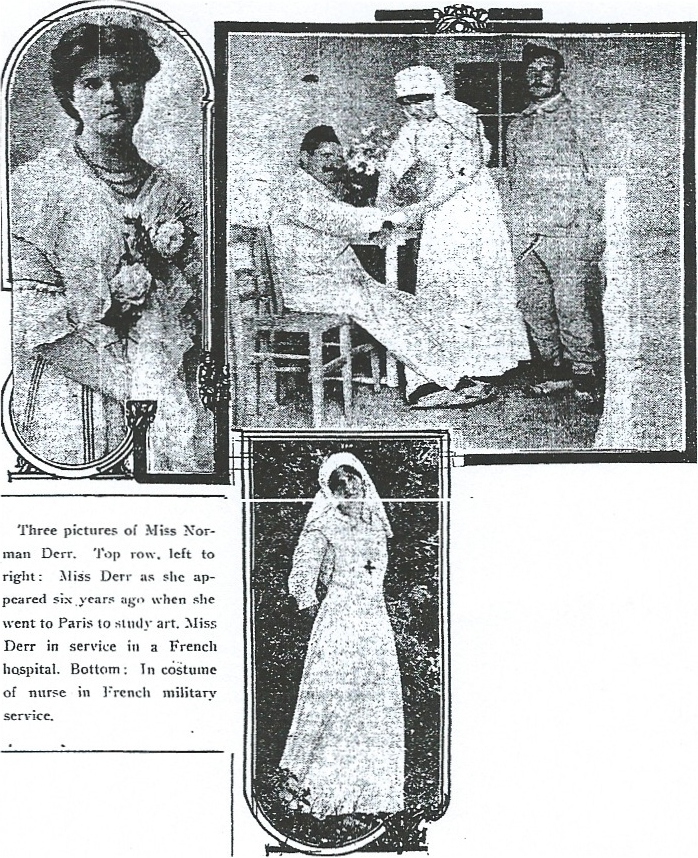
The following interview was published by the ‘Atlanta Constitution’ on 7th October 1916 and was obtained from ‘ProQuest Historical Newspapers ‘-Atlanta Constitution (1865-1945) . I would like to thank  ‘ProQuest” for their permission to copy the article published below.  The photos that accompany the feature are believed to have been given by Norman Derr to the newspaper reporter, so once again I thank Norman’s family for their kind permission to share these images of her on this site.

3 pictures of Norman 1916

Introduction to ‘Mademoiselle Miss Continued’

19 Saturday Oct 2013

Posted by annelewis1 in Uncategorized

≈ Leave a comment

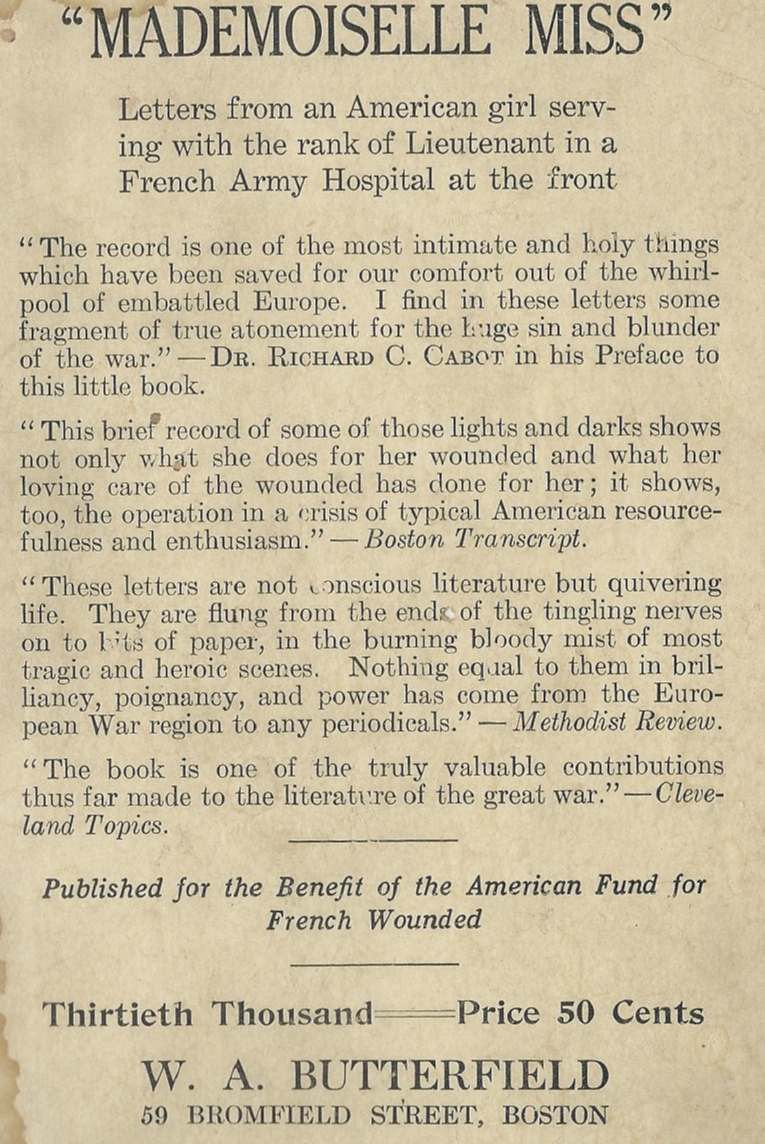
Although my WordPress blog is called “Mademoiselle Miss Continued” it may be  helpful to readers to explain why this title was chosen. Below is an extract from a book that was published in 1916 in America.

“Mademoiselle Miss”

Letters from an American Girl 
Serving with the Rank of Lieutenant 
in a French Army Hospital at the Front

INTRODUCTION

“MADEMOISELLE MISS,” as her soldiers call her, is the daughter of an ex-Medical Director of the United States Navy. At the outbreak of the war she was in France. Accepted as a helper in a small French hospital on the Riviera, she later served in an English hospital at Mentone. There she heard that an examination was to be held for a nurse’s diploma in the French Red Cross. She studied day and night, faced nine doctors in an oral examination of two and a half hours, and passed with credit. Her diploma was signed by the Minister of War; she was sent to the front as a member of the regular military organization. She serves, with the rank of lieutenant, at a French army hospital near the trenches of the Marne.

These letters, written in the heat of action, “for one and for one only,” have met with a warm response among many sympathetic hearers. Their publication now, without the knowledge of the writer, is justified only in the hope that they may reach a wider circle, and bring help to heroic France.

“Mademoiselle Miss” was published in 1916 as it states without the authors permission for the benefit of the American Fund for the French Wounded.

The letters she wrote from 1915 to 1916 in the book are available to read on the following link:

http://www.vlib.us/medical/MMiss.htm


The front cover reviews of ‘Mademoiselle Miss’ published in 1916.

Image


“Mademoiselle Miss continued

This site will  publish more of her letters that were written from 1916 -1918 which have been discovered recently.

I hope her voice will be heard nearly 100 years after she recorded her experiences during the First World War.  Her letters reflect her selfless desire to help the sick and wounded soldiers in France. I am grateful for the kind permission of her family to share these letters with a wider audience.

As noted above ‘Mademoiselle Miss’ was written anonymously however I want to share with the readers the identity of the women in this story.

Kate Norman Derr was born in New Brunswick, NJ, March 12, 1886. She was the daughter of Ezra Z. Derr, captain in the US Navy, and Julia Latham. Captain  Derr was Medical Director of the Boston and Portsmouth Navy Yards, among other posts. She went to college at Bryn Mawr but left before graduation to follow painting courses at the Boston Museum of Fine Arts where she became a proficient artist. With her aunt, Kate Crawford Latham she then went to Europe. ca,1910-1, to continue her studies, and either remained while Ms Latham returned to the US or went with her and came back alone.

She studied in Paris, Germany, Austria, Switzerland (spending a whole month at the St. Bernard). She eventually settled in Rome, had a studio via Margutta and studied  with a number of well known painters, Mancini among them.

She was superbly read, wrote with beautiful ease and elegant style, spoke and wrote  French, German, Italian, and Spanish fluently, was at home in the history of art, knew music, and played piano.

Although she was christened Kate Norman Derr she preferred to be called Norman Derr, the name she used throughout her adult life.

Image

This is a photo of her wearing her French nurses uniform.

Newer posts →

Subscribe

  • Entries (RSS)
  • Comments (RSS)

Archives

  • December 2017
  • January 2017
  • September 2016
  • January 2015
  • December 2014
  • March 2014
  • February 2014
  • January 2014
  • December 2013
  • November 2013
  • October 2013

Categories

  • Uncategorized

Meta

  • Create account
  • Log in

Create a free website or blog at WordPress.com.

Privacy & Cookies: This site uses cookies. By continuing to use this website, you agree to their use.
To find out more, including how to control cookies, see here: Cookie Policy
  • Subscribe Subscribed
    • Mademoiselle Miss Continued
    • Already have a WordPress.com account? Log in now.
    • Mademoiselle Miss Continued
    • Subscribe Subscribed
    • Sign up
    • Log in
    • Report this content
    • View site in Reader
    • Manage subscriptions
    • Collapse this bar
 

Loading Comments...